

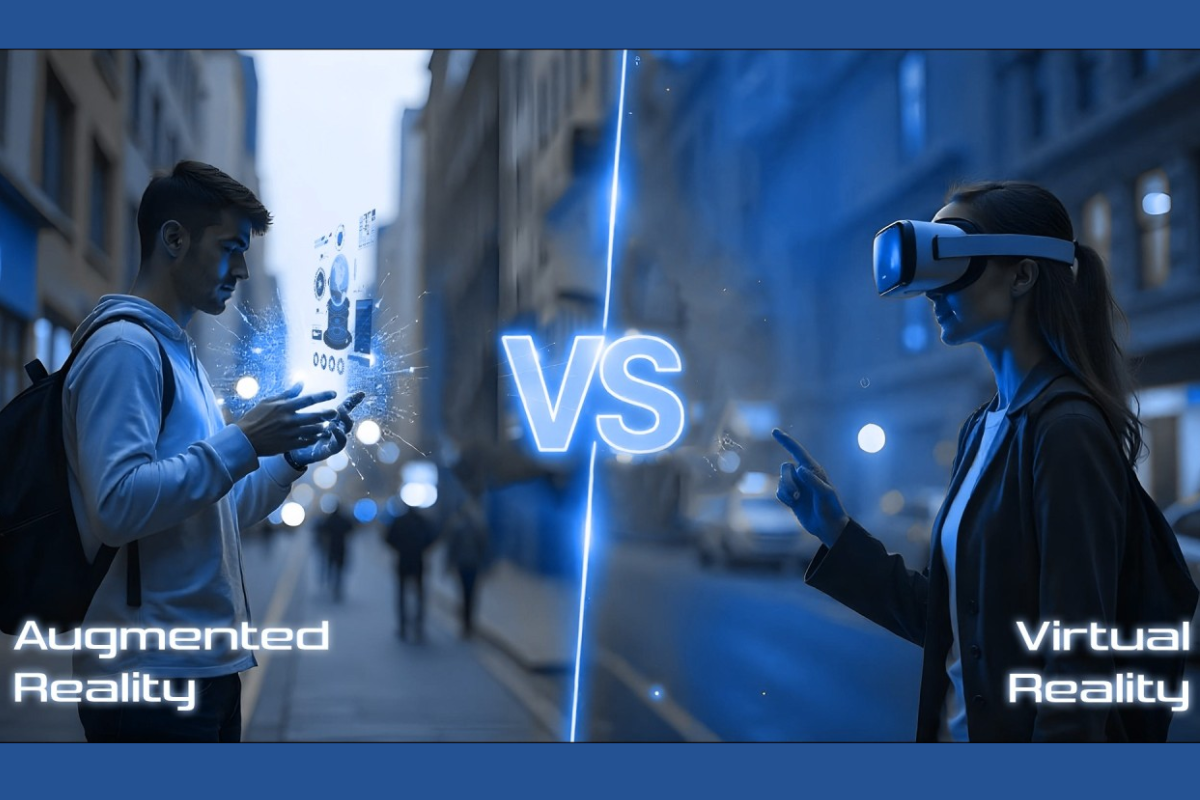
Technologies like Virtual Reality (VR) and Augmented Reality (AR) are transforming the way we experience the world. From gaming and entertainment to education and industrial applications, both VR and AR have become indispensable tools for innovation. However, many people often confuse VR with AR, thinking they are the same. In reality, while both technologies create immersive experiences, they do so in very different ways. This blog will explore the key differences between Virtual Reality and Augmented Reality, their applications, benefits, challenges, and pricing considerations.
What is Virtual Reality (VR)?
Virtual Reality (VR) is a fully immersive technology that simulates a computer-generated environment. When using VR, users are completely isolated from the real world and are placed in a 3D virtual space. This experience is usually achieved through specialized VR headsets like Oculus Quest, HTC Vive, or PlayStation VR.
Key Features of VR:
- Complete immersion in a virtual environment.
- Interactivity with virtual objects using controllers.
- Often used in gaming, simulations, and training programs.
- Requires VR-compatible hardware for full experience.
Benefits of VR:
- Enhanced Learning & Training: Simulations for pilots, surgeons, and industrial workers.
- Immersive Gaming Experiences: Feel part of the game environment.
- Remote Collaboration: Virtual meetings in 3D spaces.
- Mental Health Therapy: VR is used for stress relief, phobia treatments, and meditation.
What is Augmented Reality (AR)?
Augmented Reality (AR), on the other hand, overlays digital content on the real-world environment. Unlike VR, AR does not replace reality; instead, it enhances it by adding visual elements, sound, or other sensory information. AR is widely accessible through smartphones, tablets, and AR glasses like Microsoft HoloLens.
Key Features of AR:
- Real-world environment enhanced with digital content.
- Interactive and overlay-based experience.
- Compatible with mobile devices and AR glasses.
- Often used in marketing, navigation, and e-commerce.
Benefits of AR:
- Interactive Marketing: Brands can engage customers using AR ads.
- Improved Learning: AR textbooks and apps enhance understanding of concepts.
- Navigation Assistance: AR directions overlay on real-world streets.
- Industrial Applications: Workers can view machine data directly on the device.
VR vs. AR – Key Differences Table
Here’s a comprehensive table summarizing the differences between Virtual Reality and Augmented Reality:
| Factor | Virtual Reality (VR) | Augmented Reality (AR) | Best Use Cases |
|---|---|---|---|
| Immersion | Fully immersive; blocks real world | Partially immersive; overlays digital info | VR for gaming & simulations; AR for marketing |
| Hardware Required | VR headsets, controllers | Smartphones, tablets, AR glasses | VR for professional training; AR for consumer apps |
| Environment | Entirely virtual | Real-world enhanced | VR for 3D simulations; AR for real-world navigation |
| User Interaction | Users interact with virtual objects | Users interact with real-world objects + digital | VR for virtual training; AR for interactive retail |
| Cost | High-end VR setup: $300–$1500+ | AR apps & devices: $0–$500+ | VR for specialized use; AR for mass adoption |
| Development Complexity | Requires complex 3D modeling and software | Less complex; overlays can be simpler | VR for high-end experiences; AR for apps & websites |
| Applications | Gaming, training, virtual tours | E-commerce, navigation, education | Choose based on user engagement & interactivity |
| Portability | Limited, mostly stationary setups | Highly portable on mobile devices | VR for controlled environments; AR for mobility |
| Sensory Feedback | Visual, auditory, sometimes haptic | Mostly visual & auditory | VR for full sensory immersion; AR for info overlay |
| Learning Curve | Steeper, requires headset adjustment | Minimal, easy to access via mobile devices | VR for immersive learning; AR for easy adoption |
Applications of VR and AR
VR Applications:
- Gaming & Entertainment: Immersive 3D games and virtual concerts.
- Education & Training: Flight simulators, surgical simulations.
- Virtual Tours: Real estate or museum experiences.
- Healthcare: Pain management, therapy sessions, mental health treatments.
AR Applications:
- Retail & E-Commerce: Try-on solutions for clothes and furniture.
- Navigation: AR-based GPS and street directions.
- Maintenance & Repairs: Overlay technical instructions on machines.
- Education: Interactive learning apps for students.
Pricing Overview
Here’s a breakdown of typical VR and AR equipment and software pricing:
| Category | VR Cost (USD) | AR Cost (USD) | Notes |
|---|---|---|---|
| Headsets/Glasses | $300–$1500 | $100–$500 | High-end VR vs consumer AR devices |
| Controllers / Accessories | $50–$200 | $0–$100 | Optional for AR; essential for VR |
| Software / Apps | $0–$50 per app | $0–$20 per app | VR apps may require subscriptions |
| Development Costs | $10,000–$50,000+ | $1,000–$10,000+ | VR development more expensive |
| Training & Workshops | $500–$2,000 | $50–$500 | VR immersive sessions vs AR online tutorials |
Note: VR setups tend to be more expensive due to high hardware requirements, whereas AR can often be experienced using a smartphone or tablet.
Challenges of VR and AR
VR Challenges:
- High initial investment.
- Possible motion sickness for some users.
- Requires dedicated space for immersive experience.
AR Challenges:
- Limited field of view in devices.
- Dependence on device sensors & cameras.
- Digital overlays can sometimes be inaccurate.
Choosing Between VR and AR
When deciding whether to use VR or AR, consider the following factors:
- Goal of the Experience: Full immersion vs. enhancing reality.
- Budget: VR is costlier; AR is more affordable.
- Target Audience: VR is often niche; AR can reach a wider audience.
- Hardware Availability: Check if users have VR headsets or AR-compatible devices.
Conclusion
Both Virtual Reality and Augmented Reality are revolutionizing how we interact with digital content. While VR creates a completely virtual environment for immersive experiences, AR enhances our real-world surroundings with interactive digital elements. Businesses and consumers alike can leverage these technologies for education, entertainment, marketing, and professional training.
Understanding the key differences, benefits, challenges, and costs will help you choose the right technology for your goals.
