

Search Engine Optimization (SEO) is the backbone of digital marketing. Every website owner, blogger, and business today focuses on SEO because it helps improve visibility, attract organic traffic, and boost sales. But when we talk about SEO, two important components often come into discussion: On-Page SEO and Off-Page SEO.
While both aim to improve rankings, their methods and strategies are different. In this blog, we’ll explore what On-Page SEO and Off-Page SEO mean, their importance, differences, examples, and how you can balance both to maximize your website’s performance.
🔹 What is On-Page SEO?
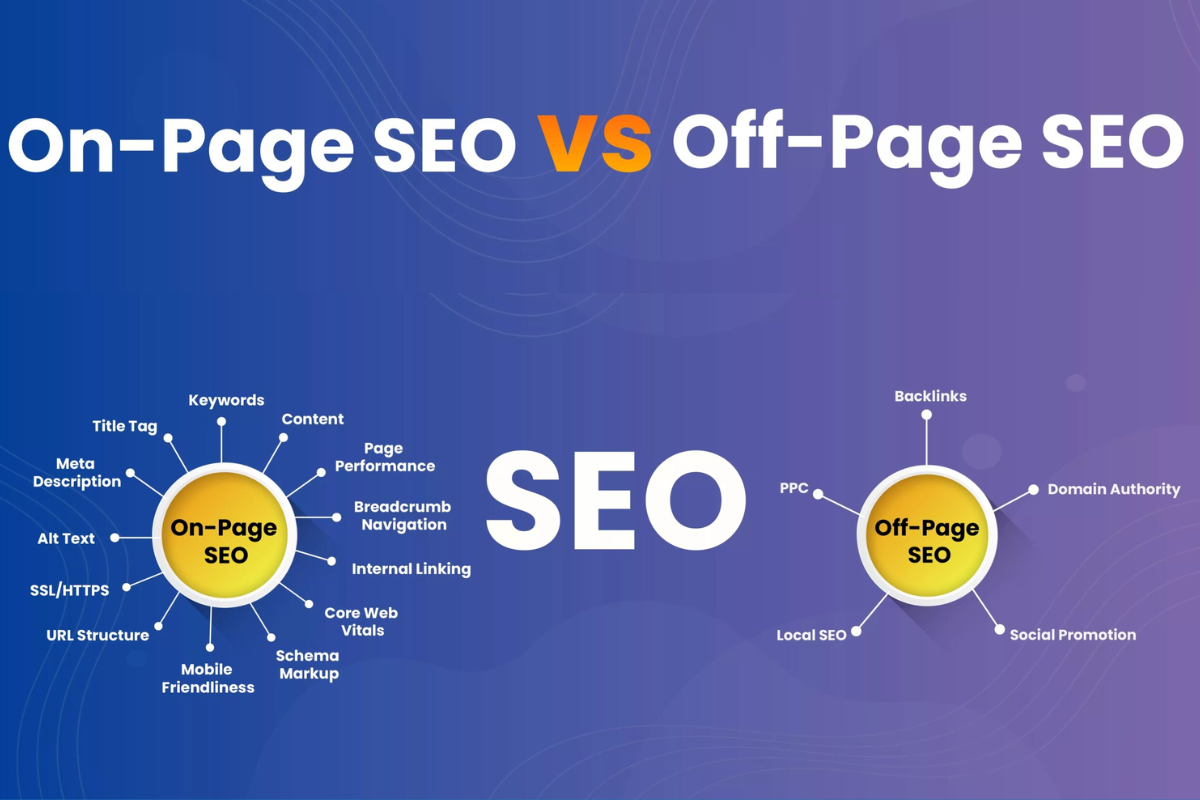
On-Page SEO refers to all the actions taken within your website to optimize it for search engines and users. It includes everything from optimizing keywords, meta tags, headings, content quality, internal linking, page speed, and mobile-friendliness.
👉 In short, On-Page SEO = Everything you control inside your website.
Key Elements of On-Page SEO:
- Keyword Optimization – Using primary and secondary keywords naturally in titles, headings, and content.
- Title Tags & Meta Descriptions – Well-written titles and descriptions improve click-through rate.
- URL Structure – Short, clean, and keyword-rich URLs are SEO-friendly.
- Content Quality – High-value, original, and informative content ranks higher.
- Image Optimization – Adding alt text, compression, and proper naming for images.
- Internal Linking – Linking your own pages for better navigation and authority distribution.
- Mobile-Friendliness – Responsive designs rank better on Google.
- Page Speed – Faster websites improve user experience and reduce bounce rate.
🔹 What is Off-Page SEO?
Off-Page SEO refers to all the strategies you apply outside your website to improve its authority, popularity, and trustworthiness. It mainly focuses on backlinks, brand mentions, and social media signals.
👉 In short, Off-Page SEO = Everything you do outside your website to promote it.
Key Elements of Off-Page SEO:
- Backlinks – Quality backlinks from authority websites improve ranking.
- Guest Posting – Publishing content on other websites to build links.
- Social Media Marketing – Promoting content on platforms like Facebook, Instagram, LinkedIn.
- Influencer Outreach – Collaborating with influencers to expand reach.
- Brand Mentions – Even without backlinks, mentions on trusted sites boost SEO.
- Forum & Community Participation – Engaging in discussions (like Quora, Reddit) helps build authority.
- Local SEO & Citations – Adding your business to local directories like Google My Business.
- Reviews & Testimonials – More positive reviews = higher trust = better SEO signals.
🔹 On-Page SEO vs. Off-Page SEO – Key Differences
Here’s a summary table that highlights the differences clearly:
Summary Table: On-Page SEO vs. Off-Page SEO
| Factor | On-Page SEO | Off-Page SEO | Best Practice |
|---|---|---|---|
| Definition | Optimization done inside the website | Optimization done outside the website | Use a balanced approach of both |
| Focus | Content quality, structure, technical elements | Backlinks, promotion, authority building | Prioritize user experience + authority |
| Control | Fully under your control | Depends on other sites and platforms | Build relationships with high-quality websites |
| Examples | Titles, keywords, headings, content, image alt tags | Link building, guest blogging, social shares, mentions | Mix content + outreach strategies |
| Impact | Improves relevancy and user experience | Improves trust, popularity, and authority | Strong combination = higher Google rankings |
| Time to Show Results | Faster (weeks) | Slower (months) | Patience + consistency is key |
| Difficulty Level | Easy to implement with SEO tools | More difficult, requires networking & quality outreach | Focus on quality, not quantity |
| Goal | To make the website search engine and user-friendly | To make the website popular and trusted | Achieve balance for sustainable growth |
🔹 Importance of Balancing On-Page and Off-Page SEO
Both On-Page and Off-Page SEO are essential for success. Think of it like this:
- On-Page SEO is the foundation of your house.
- Off-Page SEO is the reputation and trust you build in your neighborhood.
Without strong On-Page SEO, search engines won’t understand your content. Without Off-Page SEO, your site won’t get the authority needed to rank higher.
👉 Together, they create a perfect balance for long-term SEO success.
🔹 Practical Example
Suppose you write a blog about “Best Smartphones in 2025”.
- On-Page SEO: You optimize keywords like best smartphones 2025, add headings, include images, improve speed, and write detailed content.
- Off-Page SEO: You promote your article on social media, get backlinks from tech blogs, and earn mentions in gadget forums.
Result → Your blog gets high rankings and steady organic traffic.
🔹 Pricing List: On-Page SEO vs. Off-Page SEO Services
| SEO Service | On-Page SEO (Monthly) | Off-Page SEO (Monthly) |
|---|---|---|
| Basic SEO Audit | $50 – $100 | N/A |
| Keyword Research | $100 – $200 | N/A |
| Meta Tags, Headings, Content Setup | $150 – $300 | N/A |
| Technical SEO (Speed, Mobile, UX) | $200 – $400 | N/A |
| Internal Linking Optimization | $100 – $250 | N/A |
| Link Building Campaign | N/A | $300 – $600 |
| Guest Posting & Outreach | N/A | $400 – $700 |
| Social Media Promotion | N/A | $200 – $500 |
| Local SEO (Citations, Reviews) | $150 – $300 | $200 – $400 |
| Complete SEO Package | $600 – $1200 | $800 – $1500 |
(Pricing may vary depending on agency, location, and project complexity)
🔹 Conclusion
The difference between On-Page SEO vs. Off-Page SEO lies in control and purpose. On-Page SEO ensures your website is optimized for search engines and users, while Off-Page SEO builds authority and trust beyond your site.
👉 If you want long-term SEO success, don’t rely only on one – combine both for maximum results.
